- Home
- Solar geyser installation
15 years of plumbing in Kempton Park
Solar Geyser Installation
Kempton Park
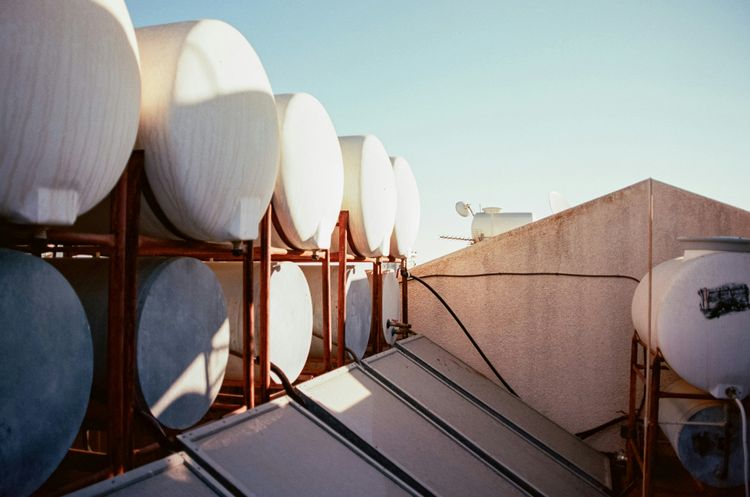
Solar geyser installation in Kempton Park, with the SANS 10106 certificate named on the quote and every roof penetration counted and sealed before the collector goes up.
Six parts of a solar geyser, from the roof to the tap
Each is a line on the quote, and the certificate covers the installation as a whole.
Collector
Flat panel or evacuated tubes, mounted on brackets where the roof gets the most sun through the day.
Storage tank
A new solar tank, or the geyser you already have kept as the store if its age and condition allow.
Flow and return pipes
The pipes between collector and tank, insulated along the stretches that run outside on the roof.
Roof entries
Every pipe and bracket that passes through the tiles or sheeting is sealed, and any tile broken during the work is replaced.
Backup and timer
The electric backup element, where the system has one, with its timer set so the sun does the work first.
SANS 10106 certificate
A certificate of compliance for the solar installation, issued when the work is complete.
The one geyser certificate that did not fall away
On 24 June 2022 the requirement to issue a certificate of compliance for an electric geyser was deleted from SANS 10254, the Plumbing Industry Registration Board reported. The same notice says CoCs "are still required for solar geysers and heat pumps in terms of other SANS codes", naming SANS 10106 for solar. So a solar installation still ends with a certificate, signed by someone putting their name to the work.
The PIRB added that "insurance companies, municipalities, manufacturers, government departments, property managers and some consumers still demand the issue of a COC". For a solar geyser nobody has to argue the point, because the code asks for one. The practical difference from an electric geyser is where the work happens: on a solar job, much of it is on the roof.
Kempton Park's roofs were tested on 30 November 2025. Hail left ice "up to 20 cm deep", broke roof tiles and gutters, collapsed carports and brought water through ceilings, and Festival Mall closed after damage to its roof. Power went off "from Spartan to Birch Acres". A 2023 hail study covering Gauteng found hail most frequent from mid-November through February, peaking in the afternoon.
A solar collector puts new holes in exactly that roof. The brackets that hold it and the pipes that run from it to the tank each pass through the tiles or sheeting somewhere, and every one of those entries is a place for rain to find. OR Tambo records about 720 mm of rain a year, most of it between October and March, so a badly sealed entry does not stay hidden for long. It shows up as a stain on a ceiling.
So a solar quote should answer two things in writing. The first is which certificate will be issued, by whom, and whether it is in the price. The second is how many times the installation goes through your roof, how each entry is sealed, and what happens to a tile that cracks under a foot or a bracket.
Ask for the SANS 10106 certificate by name on the quote, and ask how many times the installation goes through your roof and how each entry will be sealed. After the hail of November 2025, the second question matters as much as the first.
Solar faults, and where on the roof they start
Read across: what you notice, the usual cause on a solar installation, and what it needs.
Solar geysers, Kempton Park roofs
| What you notice | What it usually is | What it needs |
|---|---|---|
| A brown ring on the ceiling after rain | A pipe or bracket entry letting water in | Entry resealed, cracked tiles replaced |
| Hot only on sunny afternoons since a power cut | Backup element off, or its timer showing the wrong time | Timer reset, element and its supply checked |
| One tube looks cloudy, or one is cracked | An evacuated tube that has lost its vacuum or broken | The tube replaced and the system topped up |
| The collector sits in shade by mid-afternoon | A tree or a new building blocking the sun | Collector moved, or the shade cut back |
| Bare pipe on the roof where lagging used to be | Insulation perished in sun and weather | Pipe re-insulated along its outside run |
Most of these start on the roof, which is why the roof entries are part of the quote.
Four things a solar geyser quote here includes
They cover the parts of a solar job that are easiest to leave vague: the certificate, the roof and the price.
The certificate by name
The quote names the SANS 10106 certificate of compliance as its own line, so it is part of the price you accept and not an extra later.
Roof entries counted
How many times the installation passes through your roof, and how each entry is sealed, is written down before anyone climbs up.
Your geyser judged on its condition
If the geyser you have can serve as the solar store, you are told so. If its age or condition rules it out, you are shown why before a new tank is quoted.
Roof entries checked first
If a mark appears on a ceiling after heavy rain, report it through the same form, and the roof entries are the first thing checked.
Four steps, roof survey to certificate
Each step waits for your go-ahead. No date is given until it has been booked with you.
Send the request
Use the form: your roof type, where the geyser is, and whether you want to keep it. The call back covers ladder access and the cost of the survey visit.
Survey roof and tank
The plumber checks where the collector can sit, the state of the roof covering, the pipe route to the tank and the geyser you have now.
Quote line by line
Collector, tank or conversion, pipework, roof sealing, backup and the certificate, each priced. You choose before a date is set.
Mount, seal, certify
Brackets and pipes go in, every roof entry is sealed, the system is filled and run, and the certificate of compliance is issued.
Related work in Kempton Park
Asked before a solar geyser goes up
If your roof or geyser raises a different question, note it in the call-out form.
What decides the price of a solar geyser on a Kempton Park roof?
The roof, the tank and the collector, so it is priced after a survey rather than over the phone. Roof type and access, whether your existing geyser can be kept, the size and type of collector, the pipe run, the roof sealing and the certificate are each a line on the written quote.
No solar price is published here, and the visit charge is explained on the phone-back before anything is booked. The plumbing prices page sets out how that works.
Does a solar geyser still need a CoC now that electric geysers do not?
Yes. The PIRB reported that when the electric-geyser CoC was deleted from SANS 10254 in June 2022, CoCs stayed required for solar geysers under SANS 10106 and for heat pumps under SANS 1352.
The certificate is named on the quote here and issued when the installation is complete. Keep it with your policy documents, since the PIRB also notes that insurers still ask for CoCs.
Our roof was hit by the November hail. Can a collector go on it?
Once the roof covering under and around it is sound, yes. The storm of 30 November 2025 broke roof tiles in Kempton Park, and a cracked tile under a bracket lets the next rain in.
The roof is checked on the survey. If tiles need replacing first, that is said and priced before the collector goes up, and if the damage is part of an open insurance claim, let that repair happen first.
Will the holes for the pipes make our roof leak?
Not if each entry is sealed properly, and that is checked rather than assumed. The quote lists each bracket and pipe that goes through the tiles or sheeting, and how each one will be sealed against rain.
Tiles that crack during the work are replaced as part of the job. If a stain appears after the first heavy rain, send the form and the roof entries are the first thing checked.
We put in a new electric geyser last year. Does it have to go to add solar?
Not necessarily. A geyser in good condition can serve as the store for a solar collector, and whether yours can is checked on the survey.
If its size, age or connections rule it out, you are shown why before a new solar tank is quoted. Either way the result is a solar installation, so the SANS 10106 certificate still applies.
After several overcast days in summer, what keeps the water hot?
The electric backup element, where the installation has one, and the quote states whether it does. On bright days the sun should do most of the work and the element should barely run.
After a power cut, look at the timer. Eskom reminds households to reset the time-control clocks on geysers once power returns, and a timer showing the wrong time can leave the backup off when you need it.
After a storm claim, what solar paperwork will the assessor want?
Expect to be asked for the certificate of compliance and the installation invoice. The PIRB notes that insurance companies still demand CoCs, and for a solar geyser SANS 10106 still requires one.
Keep the certificate, the invoice that lists the collector, tank and roof work, and a few photographs of the installation together. Each insurer decides what it needs, so the claims line has the final word.
Why does someone need to go up on the roof before there is a quote?
Because much of the job happens there. The survey checks the roof type and pitch, the state of the tiles or sheeting, where the collector gets sun for most of the day, and how far the pipes must run to the tank.
A quote written without that is a guess at the roof work, and the roof work is what keeps the ceiling dry.
Where we work
Every suburb inside Kempton Park, from Birchleigh North down to Bonaero Park on the airport fence.
- Kempton Park CBD
- Allen Grove
- Aston Manor
- Birch Acres
- Birchleigh
- Birchleigh North
- Bonaero Park
- Bredell
- Cresslawn
- Croydon
- Edleen
- Esther Park
- Glen Erasmia
- Glen Marais
- Isando
- Kempton Park West
- Nimrod Park
- Norkem Park
- Pomona
- Rhodesfield
- Serengeti
- Spartan
- Terenure
- Van Riebeeck Park